Turnitin vs. Grammarly vs. SafeAssign vs. Copyleaks: How They Actually Compare
Four tools, four different source pools, and four different reasons your score might not match what a friend at another school sees. Here's what each one actually checks against — and why the tool matters more than the score.
The quick answer
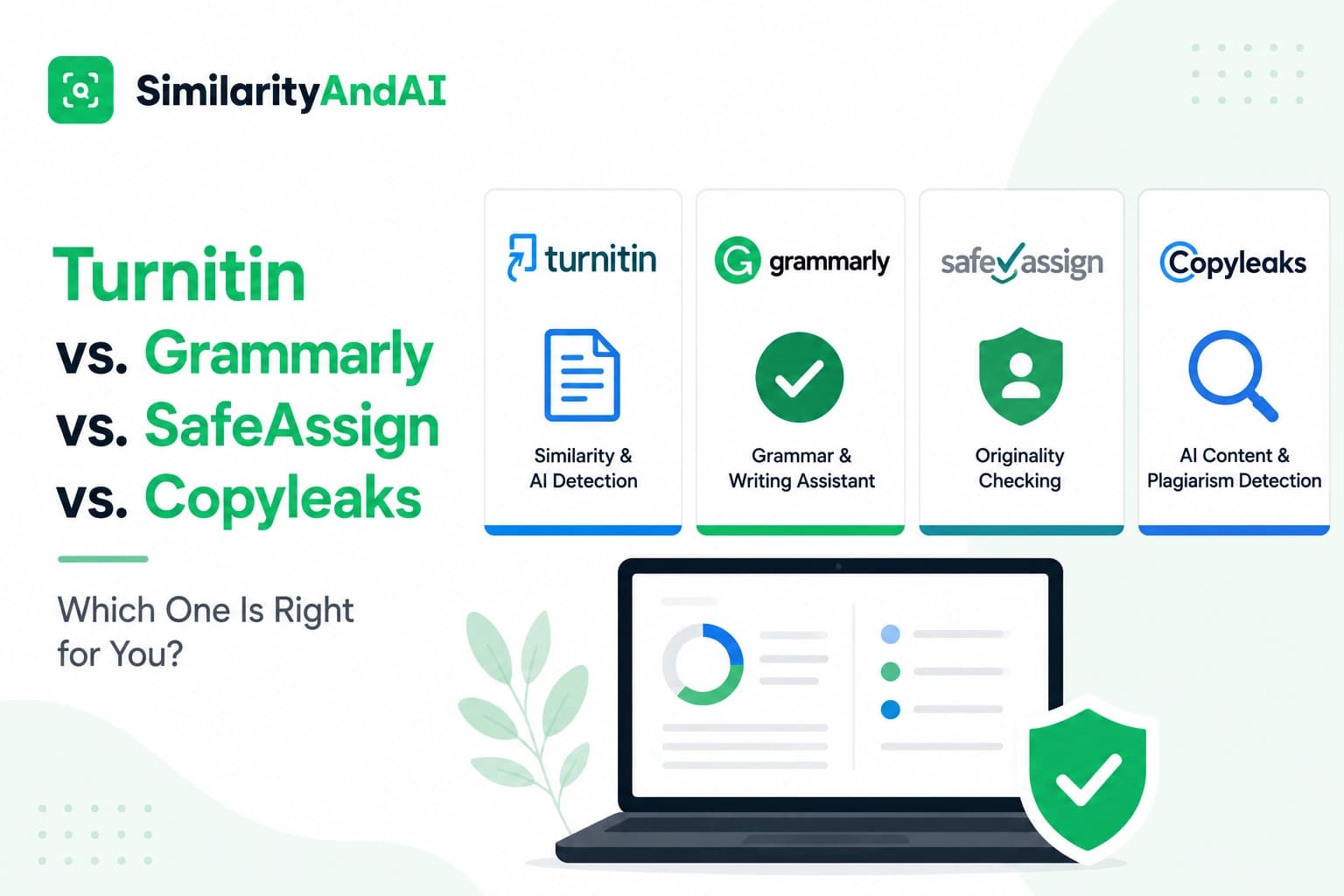
These four tools aren't competing versions of the same product — they're built for different customers, licensed against different source pools, and sold through different channels. Turnitin and SafeAssign are institutional systems your school licenses and controls; Copyleaks is sold both to institutions and directly to businesses and individuals through an API; Grammarly is a consumer writing app with a plagiarism feature bolted on. The practical question for a student isn't which one is "best" in the abstract — it's which one your specific institution actually uses, since that's the only score that will matter when you submit for real.
Why comparing these tools honestly is harder than it looks
Search around for "Turnitin vs. Copyleaks accuracy" and you'll find a lot of specific-looking percentages — 95% this, 99.8% that. Worth treating with real skepticism: many of these figures come from blogs published by, or affiliated with, one of the competing tools, testing against samples and methodologies that aren't disclosed or independently verified. A vendor-run test that concludes its own product wins isn't neutral evidence, even when it's presented as one. This article sticks to what each company states about its own product and how the tools are structurally different, rather than repeating contested accuracy claims as settled fact.
Turnitin: the institutional standard
Turnitin is licensed to institutions, not sold to individuals — a distinction covered in more depth in our comparison of Turnitin and free plagiarism checkers. Per Turnitin's own materials, it's used by more than 16,000 institutional customers across roughly 185 countries, comparing submissions against an index of web content, a licensed database of academic publications, and a large cross-institutional repository of previously submitted student papers. That cross-institutional student-paper layer — seeing submissions from other schools that also use Turnitin — is one of the more distinctive parts of its coverage, and it's not something every competing tool has access to at the same scale.
SafeAssign: Blackboard's built-in checker
SafeAssign is built into Blackboard Learn and compares submissions against four sources: your institution's own archive of previously submitted papers, Blackboard's Global Reference Database (student work voluntarily contributed by other Blackboard-using institutions), the ProQuest ABI/INFORM journal database, and the open internet via an internal search service. If your school runs Blackboard rather than Canvas or Moodle, SafeAssign — not Turnitin — may well be the tool your actual assignments go through.
The key structural difference from Turnitin is scale and source diversity: SafeAssign's reference database and journal access are narrower than Turnitin's licensed academic publishing index, and its cross-institutional paper pool depends on other schools choosing to contribute — participation Turnitin's customer base doesn't require in the same way.
Copyleaks: the API-first competitor
Copyleaks positions itself differently from the start — it's sold to institutions, but also directly to businesses, publishers, and developers through an API, which is a meaningfully different distribution model than Turnitin's institution-only licensing. Per its own product materials, Copyleaks compares submissions against a large index of web content and academic sources, and its AI detection layer combines pattern-based writing analysis with what it calls AI Source Match, comparing text against known AI-generated content directly.
A small but real number of institutions have adopted Copyleaks as their primary integrity tool, particularly through Canvas integrations, so it's not purely a niche or business-only product — but it doesn't have Turnitin's decades-long, near-default position in higher education, and its student-paper coverage doesn't match Turnitin's cross-institutional repository in scale.
Grammarly: the consumer-facing outlier
Grammarly is the odd one out here, and worth separating clearly from the other three: it's a consumer product first, sold directly to individuals as a writing assistant, with a plagiarism-checking feature included in its paid tier. Per Grammarly's own product page, its checker compares text against web content and a set of licensed academic databases through ProQuest. It has no access to any institution's private submission archive and no cross-institutional student-paper repository at all, because it isn't built around institutional licensing the way Turnitin, SafeAssign, and (in its institutional form) Copyleaks are.
This makes Grammarly genuinely useful as a personal writing tool and a reasonable first-pass check on your own original writing, but it is not a stand-in for what your school's actual assignment tool will see — a distinction that matters most exactly when your paper draws heavily on other students' work being checked institutionally, which Grammarly simply cannot see.
Side by side: what each one actually checks against
- Turnitin. Web content, a large licensed academic publications database, and a broad cross-institutional student paper repository. Institution-licensed only.
- SafeAssign. Your institution's archive, Blackboard's Global Reference Database (voluntary cross-institution contribution), the ProQuest ABI/INFORM database, and the open web. Bundled into Blackboard Learn.
- Copyleaks. Web content and academic sources, plus AI-specific pattern and source matching. Sold to institutions and directly to businesses/developers via API.
- Grammarly. Web content and licensed academic databases via ProQuest. No institutional or cross-student repository access. Sold directly to individuals.
Why your score won't match across tools
This is the practical takeaway underneath all of the above: the same paper can return meaningfully different scores on each of these tools, and that's not a sign that any one of them is broken. Each score reflects only what that specific tool was able to compare your text against. A paper that draws on journal articles inside Turnitin's licensed publications index but not Grammarly's might score very differently between the two — not because Grammarly is less rigorous in general, but because it literally cannot see the source your text overlaps with.
The same logic applies to AI detection scores across tools, a subject covered in more depth in our piece on Turnitin's AI detector accuracy and false positive rate — different detection models, trained differently, will not always agree on the same document.
Which one does your school actually use?
This is worth confirming directly rather than assuming, since institutions do change providers and different departments within the same school sometimes use different tools. Check your syllabus, look at the branding on your assignment submission page inside your learning management system (a "SafeAssign" tab looks and behaves differently from a "Turnitin" or "Originality" tab), or simply ask your instructor which system your work will actually go through. Whatever your school uses is the only score that counts — everything else is, at best, an approximation.
The bottom line
Turnitin, SafeAssign, Copyleaks, and Grammarly are structurally different products serving different markets, not four competitors offering the same thing at different accuracy levels. The database each one checks against — and who they license their access to — matters more than any single headline accuracy number, especially ones published by a competing vendor about itself. If you want to know what your instructor will actually see, the only reliable approach is checking against the exact tool your institution uses.
If that tool is Turnitin, you can check your reports through SimilarityAndAI — the same Turnitin engine your institution runs, delivered per report, before you submit for real.
Frequently asked questions
Which is more accurate: Turnitin or SafeAssign?
They're not measuring the same thing, so "more accurate" isn't quite the right question. SafeAssign compares against a smaller pool — an institutional archive, Blackboard's Global Reference Database, the ProQuest ABI/INFORM journal database, and the open web. Turnitin's licensed academic publications database and cross-institutional student paper repository are substantially larger. A paper can score very differently on each simply because of what's available to compare against, independent of either tool's underlying matching quality.
Does Grammarly's plagiarism checker use the same database as Turnitin?
No. Grammarly checks against web content and a licensed set of academic databases through its own consumer product, entirely separate from Turnitin's institutional repository and cross-institution student paper database. A clean Grammarly result doesn't predict what Turnitin would find, particularly against other students' submitted work, which Grammarly has no access to at all.
Can I check which tool my school actually uses?
Usually yes — check your syllabus, your learning management system's assignment submission page (the branding is often visible, e.g. a "SafeAssign" or "Turnitin" tab in Blackboard or Canvas), or simply ask your instructor directly. Guessing based on what your school used in a previous course isn't reliable, since institutions do switch providers.
If I get a low score on one of these tools, is my paper safe everywhere else?
Not necessarily. Each tool's score reflects only what it was able to compare your text against. A low score on a smaller-database tool doesn't guarantee a low score on a more comprehensive one — the only reliable way to know what your institution will actually see is to check against the same tool and database it uses.
Ready to check your paper?
Get your Turnitin reports in minutes.
Same reports your institution generates — delivered privately, fast.
Related articles