How to Check a Thesis or Dissertation on Turnitin
Long documents hit real limits Turnitin doesn't advertise clearly — page counts, file size, and chapter splitting. Here's exactly what those limits are, how to work within them, and what changes once you're checking hundreds of pages instead of one essay.
The quick answer
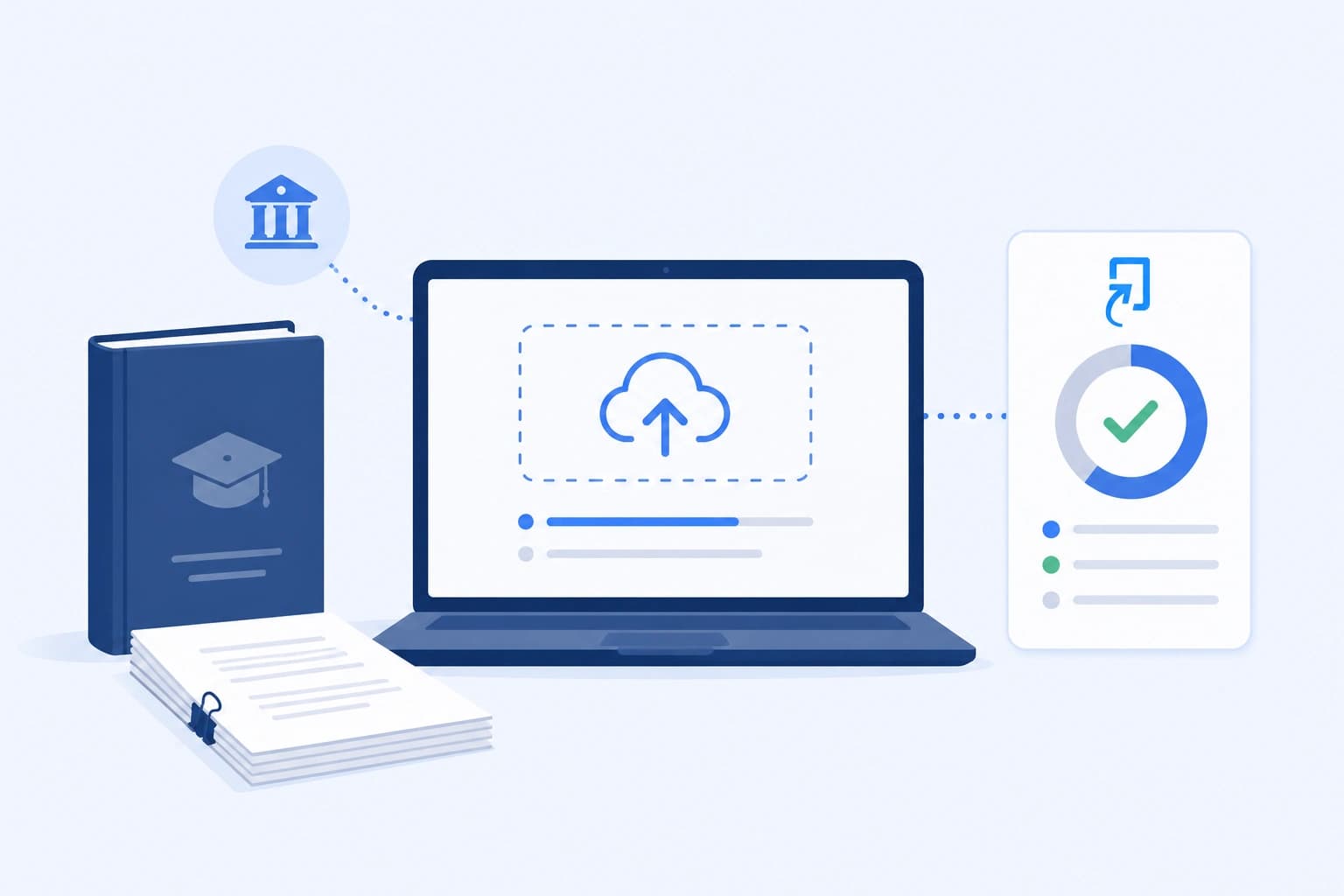
Turnitin can check a full thesis or dissertation, but it enforces real, hard limits that most students don't discover until they hit one: a maximum of 800 pages and 100MB per file, per Turnitin's own file requirements documentation. Most dissertations fall comfortably within the page limit, but file size is where long documents with embedded images or diagrams tend to run into trouble first. Many institutions handle this by having students submit chapter by chapter rather than as one combined file — each chapter generating its own separate report rather than a single unified score.
The hard limits: pages, size, and format
Turnitin's stated requirements apply regardless of document type — a 10-page essay and an 800-page dissertation are subject to the exact same technical ceiling. The two limits that actually matter for long-document submissions: page count must stay under 800 pages, and file size must stay under 100MB (with a much tighter 2MB cap specifically for plain .txt files, which is essentially never the right format for a formatted thesis anyway). These limits are covered in more general terms in our piece on the file types Turnitin accepts, but they become genuinely relevant, rather than a footnote, once you're working with a document this long.
Why long documents actually hit these limits
In practice, dissertations rarely hit the 800-page ceiling on text alone — even a lengthy PhD thesis in the 300–400 page range has room to spare. File size is the more common trigger, and it's almost always driven by embedded content rather than the writing itself: high-resolution figures, scanned appendices, embedded datasets, or a large number of diagrams can push a document's file size well past 100MB even when the actual page count is unremarkable. If your document is being rejected on upload, checking the file size before assuming the text itself is somehow too long is usually the faster diagnosis.
Splitting a thesis into chapters
Where a document exceeds Turnitin's limits — or where an institution simply prefers it for review purposes — splitting a thesis into individual chapter files and submitting them together is a standard, widely supported approach. Turnitin accepts multiple documents submitted as a batch, and each one is processed and reported on separately rather than merged into a single combined similarity score. Institutional practice varies on exactly how this should be done — some graduate schools have specific requirements for which sections get their own file versus which get grouped together — so checking your program's formatting and submission guide before splitting anything is worth doing rather than assuming a generic approach applies.
What chapter-splitting means for your overall score
This is a genuinely important practical consequence: if your thesis is submitted as separate chapter files, you won't get one overall percentage for the whole document — you'll get a separate report, and a separate percentage, for each chapter. A methodology chapter built on standardized language might show a very different number than a literature review chapter built on extensive quoted material, and neither number necessarily represents what a single combined score would have looked like. When reading feedback on a chapter-split submission, it's worth evaluating each report on its own terms rather than trying to average them into one figure that doesn't actually exist anywhere in the system.
Images, diagrams, and appendices
Turnitin analyzes text, not visual content — a point covered in more detail in our piece on file types, and worth restating specifically for thesis work, since dissertations tend to carry far more visual material than a typical essay. Charts, figures, photographs, and scanned diagrams embedded in your document are not scanned for textual originality. They do count toward your overall file size, though, which is precisely why institutions sometimes recommend compressing images, converting particularly large figures to lower resolution, or in some cases excluding certain appendix material specifically to get a file under Turnitin's size cap — not because that content is being evaluated differently, but because it's taking up space the text-checking process doesn't actually need.
Why dissertations legitimately run higher similarity scores
This connects directly to the broader question covered in our piece on what similarity percentage is too high: research-heavy documents naturally generate more textual matches than shorter, less citation-dense writing. A dissertation typically includes an extensive literature review quoting and paraphrasing dozens of sources, a methodology section that may reuse standardized, field-common language, and a reference list that is, by definition, text matching other publications listing the same sources. None of this is inherently a problem — it's simply what a properly researched, properly cited long document looks like when measured by raw textual overlap. A percentage that would raise eyebrows on a five-page essay is often unremarkable on a 200-page thesis.
A practical pre-submission checklist
- Check your file size first. Before worrying about content, confirm your document is under 100MB — this is the limit most theses actually hit.
- Confirm your institution's specific submission process. Some graduate schools require chapter-by-chapter submission as standard practice; others accept a single combined file up to the limit. Don't assume — check your program's formatting guide.
- Compress or reduce image resolution if needed. This addresses file size without touching the actual text being checked.
- Read each chapter's report on its own terms if split. Don't try to mentally average separate chapter scores into one number that doesn't exist in the system.
The bottom line
Checking a thesis or dissertation on Turnitin works fundamentally the same way as checking any shorter document, but the practical mechanics — file size limits, chapter splitting, and naturally higher baseline similarity — become real considerations at this length in a way they simply aren't for a five-page essay. Knowing the actual limits in advance, and understanding why a higher score on research-heavy writing isn't automatically a red flag, avoids a lot of unnecessary last-minute scrambling before a submission deadline.
If you want to check a chapter or your full document before your official submission, you can check your reports through SimilarityAndAI — the same Turnitin engine your institution uses.
Frequently asked questions
What's the maximum length Turnitin will accept for a dissertation?
Per Turnitin's own file requirements, a submission must be under 800 pages and under 100MB in file size. Most dissertations and theses fall within these limits on their own, but documents with many embedded high-resolution images or diagrams can hit the size cap well before the page cap.
Can I submit my thesis chapter by chapter instead of as one file?
Yes, and many institutions specifically recommend or require this for long documents. Turnitin allows multiple documents to be submitted together, with each one generating its own separate similarity report rather than a single combined score. Check your specific graduate school or research office's guidance, since institutional requirements for how chapters should be split and submitted vary.
Why does my dissertation have a much higher similarity score than a typical essay?
This is expected and doesn't necessarily indicate a problem. Longer, research-heavy documents cite far more sources, include extensive literature reviews, and often reuse standardized methodology language — all of which registers as textual matches regardless of proper attribution. A percentage that would be unusual for a short essay is often normal for a dissertation.
Do images and diagrams in my thesis get checked for plagiarism?
No — Turnitin analyzes text, not visual content, so images, charts, and diagrams embedded in your document aren't scanned for originality themselves. They do, however, count toward your file size, which is part of why documents with many high-resolution images sometimes need images removed or compressed just to fit within Turnitin's upload limits.
Ready to check your paper?
Get your Turnitin reports in minutes.
Same reports your institution generates — delivered privately, fast.