Does Turnitin Detect ChatGPT, QuillBot, and AI Paraphrasing Tools?
Turnitin doesn't look for a specific tool's fingerprint — it analyzes the writing itself. Here's what that actually means for raw ChatGPT text, paraphrased AI content, and where detection gets less reliable.
The quick answer
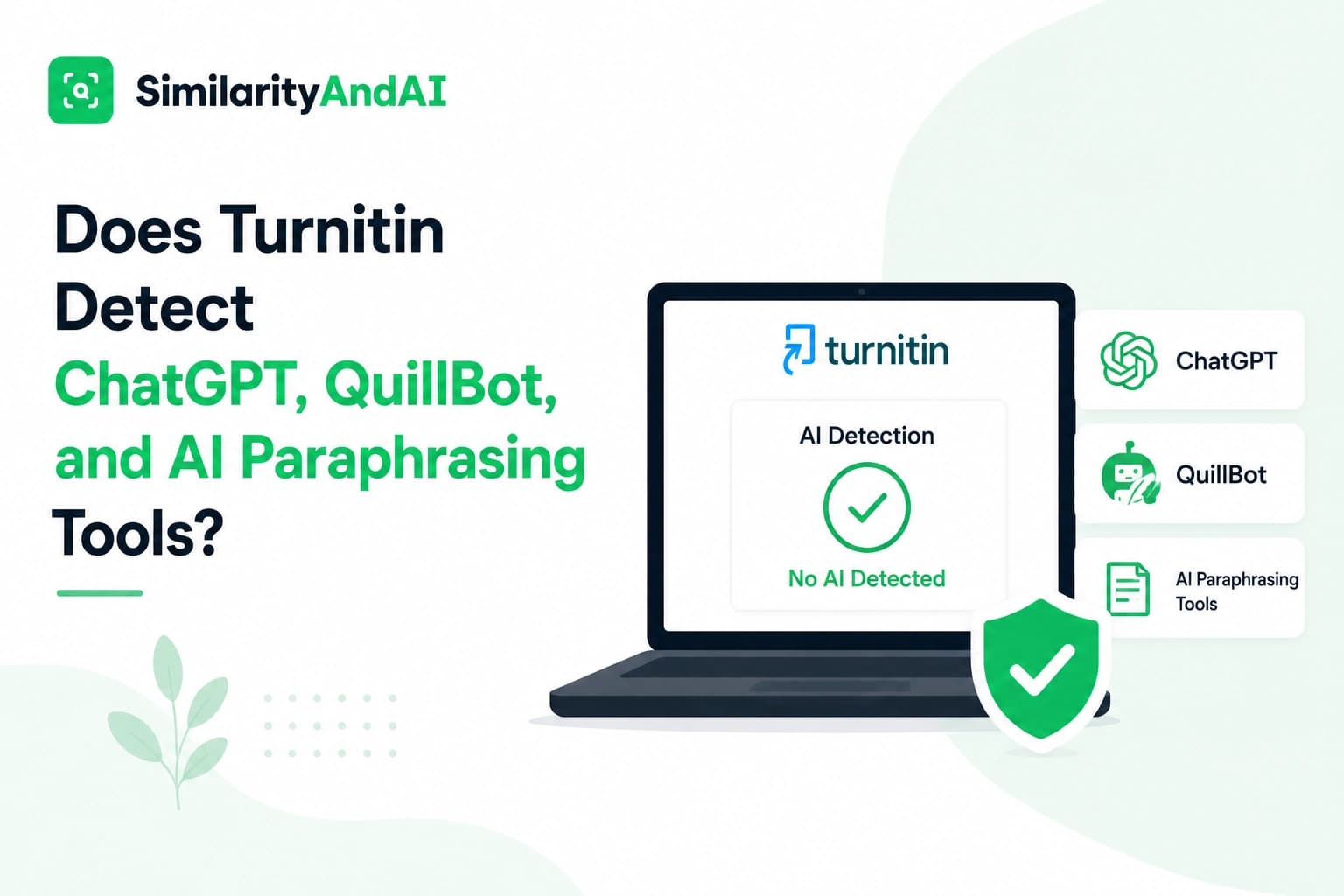
Yes, generally — but not by recognizing a specific tool. Turnitin's AI writing detector doesn't maintain a fingerprint database for ChatGPT, QuillBot, or any other named product. It analyzes the statistical properties of the text itself — how predictable the word choices are, how much sentence structure varies — and flags writing that resembles patterns typical of AI generation, regardless of which tool produced it. That approach catches a lot of AI-assisted writing reasonably well, including a fair amount of paraphrased AI text, but it isn't uniform: raw, unedited AI output is caught far more reliably than heavily revised or mixed human-and-AI writing.
How detection actually works — it's not a fingerprint match
Turnitin describes its own detection model as model-agnostic: it isn't trained to recognize output from one specific system, but to distinguish statistical patterns common across AI-generated text in general. Two properties drive most of the scoring — perplexity, how predictable each word choice is, and burstiness, the variation in sentence length and structure across a passage. AI-generated text tends to run low on both: consistently predictable phrasing and fairly uniform sentence rhythm, compared to the more irregular patterns typical of human writing.
This matters for the ChatGPT-specific question: it means Turnitin isn't checking "was this written by ChatGPT" — it's checking "does this read statistically like AI-generated text," which happens to catch output from ChatGPT, Gemini, Claude, and other large language models under the same detection approach, without needing to know which one was used.
Raw ChatGPT and other LLM text
This is where Turnitin's detector performs most reliably. Text generated directly by a large language model and submitted with little or no editing tends to exhibit the low-perplexity, low-burstiness pattern most clearly, since there's been no human revision to introduce the irregularity typical of human writing. Turnitin's own published testing claims accuracy above 98% with a false positive rate under 1% specifically on documents where AI content exceeds roughly 20% of the text — a figure covered in more depth in our piece on Turnitin's AI detector accuracy and false positive rate. Unedited AI text is, in effect, the easiest case for the detector.
AI-generated vs. AI-paraphrased: two different labels
Turnitin's AI writing report has historically distinguished between two categories: text that appears directly AI-generated, and text that appears to have been AI-generated and then run through a secondary paraphrasing or word-spinning tool. That distinction exists specifically because paraphrased AI text behaves differently from raw output — the surface wording changes, but the underlying structural patterns the detector looks for often persist to some degree. Turnitin has more recently moved toward simplifying this into a single unified AI-writing indicator rather than two separate categories, but the underlying detection logic — looking for AI-typical patterns regardless of a secondary rewriting pass — is the same.
QuillBot and other paraphrasing tools specifically
Turnitin does not detect that QuillBot, specifically, was used — again, it isn't tool-aware. What it can do is flag text that still carries AI-typical statistical patterns even after paraphrasing, which is common with simpler paraphrasing tools that primarily swap synonyms and lightly restructure sentences without changing the underlying predictability of the text. Turnitin has stated its model receives regular updates specifically aimed at catching these secondary-modification patterns, which narrows the gap over time for lighter-weight paraphrasing approaches.
It's worth being precise about what this does and doesn't mean: using QuillBot or a similar tool to paraphrase your own original writing is a different situation entirely from using it to disguise AI-generated content. The tool itself isn't the issue — what matters is whether the underlying ideas and writing are genuinely the student's own.
AI "humanizers" and bypasser tools
A separate category of tools markets itself specifically around evading AI detectors — often branded as "humanizers" or "bypassers." Turnitin has publicly announced that it added dedicated detection capability aimed specifically at text modified by these tools, describing it as a direct response to their growing use. Claimed success rates from bypasser tools vary widely across the market and aren't independently verified by any neutral party — they're marketing claims from companies selling detection evasion, which is a fundamentally different kind of evidence than Turnitin's own published testing methodology.
None of this changes the actual academic integrity question underneath it. Whether or not a piece of text technically evades a detector in a given moment, submitting AI-generated work as your own original writing is the issue a detector is trying to surface in the first place — and detection systems, on both sides, keep changing.
Where detection genuinely gets less reliable
Across Turnitin's own disclosures and independent testing, detection accuracy consistently declines in a few specific situations:
- Heavily edited AI text. Substantial human revision after AI generation reintroduces the irregularity — varied sentence length, less predictable word choice — that the detector associates with human writing.
- Mixed human-and-AI writing. A document that blends genuinely human-written sections with AI-generated ones is harder to score cleanly than a document that's uniformly one or the other.
- Short passages. Less text gives the model less statistical signal to work with, which is part of why Turnitin doesn't generate AI scores for documents below its minimum length threshold at all.
These aren't loopholes so much as acknowledged limitations of statistical detection generally — the same limitations apply, to varying degrees, across every AI detector on the market, not just Turnitin's.
What this means if you use these tools legitimately
If you use ChatGPT for brainstorming or an early outline and then write the actual submission yourself, or use QuillBot to improve the phrasing of your own original writing, you're in a fundamentally different position than someone submitting AI output directly. The detector is looking at statistical writing patterns, not tool usage logs — genuinely human-authored, human-revised writing tends to read as human, regardless of what tools touched it along the way, because the irregularity that signals human authorship comes from the actual thinking and revision process, not just the absence of a specific app.
If you're unsure how your own writing style reads to a detector — which matters more for some writers than others, as covered in our piece on AI detector false positives — checking your actual AI score before you submit is a more useful signal than guessing.
The bottom line
Turnitin doesn't recognize ChatGPT, QuillBot, or any other specific tool by name — it recognizes statistical patterns typical of AI-generated writing, which is why its detection generalizes reasonably well across different AI tools and even some paraphrasing. It's most reliable against raw, unedited AI text and least reliable against heavily revised or mixed writing, and it's been specifically updated to target text modified by humanizer and bypasser tools. None of this is a guarantee in either direction — it's a probabilistic signal, which is exactly why Turnitin itself says the score shouldn't be the sole basis for any academic integrity decision.
If you want to see your actual AI detection and similarity results before you submit, you can check your reports through SimilarityAndAI — the same Turnitin engine your institution uses.
Frequently asked questions
Can Turnitin tell specifically that I used ChatGPT?
No — Turnitin's detector is model-agnostic. It doesn't identify which AI tool was used; it analyzes statistical patterns in the writing itself, like predictability of word choice and sentence-length variation, that tend to differ between human and AI-generated text. It flags text as likely AI-generated without naming ChatGPT, Gemini, or any other specific model.
Does running AI text through QuillBot make it undetectable?
Not reliably. Turnitin's AI writing report has a specific category for text that appears AI-generated and then modified by a paraphrasing tool. Older, simple synonym-swapping paraphrasers tend to leave the underlying statistical patterns largely intact, and Turnitin's model is updated regularly, which narrows the gap for simpler tools over time.
What are AI "humanizer" or "bypasser" tools, and does Turnitin catch them?
These are tools specifically marketed to disguise AI-generated text as human-written to evade detectors. Turnitin has publicly stated it added dedicated AI bypasser detection to its model specifically in response to these tools. Effectiveness claims from bypasser tools vary widely and aren't independently verified, and none of this changes the underlying academic integrity question of whether the ideas and writing are genuinely the student's own.
Is Turnitin's AI detection equally reliable on all AI-assisted text?
No. It performs most reliably on longer stretches of unedited, directly generated AI text. Accuracy declines on heavily edited, substantially human-revised, or extensively mixed human-and-AI writing, which is a genuine and acknowledged limitation rather than a guarantee that such text goes undetected.
Ready to check your paper?
Get your Turnitin reports in minutes.
Same reports your institution generates — delivered privately, fast.
Related articles